
Tablet Press Machine Buyer’s Guide: Types, Prices & How to Choose (2026)
A tablet press machine (also called a tablet compression machine or tablet compressor) is pharmaceutical manufacturing equipment that compresses granulated or powdered material into tablets of uniform size, weight, and hardness. This guide covers every major type available in 2026, their true price ranges, the technical specifications that matter for GMP compliance, and the five purchase mistakes that cost buyers tens of thousands of dollars.
Key Takeaways
- Tablet press machines fall into two fundamental categories: single punch (up to ~4,000 tablets/hour) and rotary (5,000–1,000,000+ tablets/hour)
- Entry-level single punch presses start at $375; production-scale high-speed rotary presses reach $200,000+
- The EU-standard (B/D tooling, Euronorm) specification is now the global default for GMP pharmaceutical production — avoid non-standard tooling formats
- Turret station count is the single most important spec for rotary press output capacity — not the RPM
- Chinese rotary tablet presses offer the same ISO9001 + CE certification as European models at 40–60% lower cost, with full IQ/OQ/PQ validation documentation
Types of Tablet Press Machines
1. Single Punch Tablet Press
The single punch tablet press uses one set of upper and lower punches. Each rotation of the cam produces one tablet. This makes it the lowest-output, lowest-cost entry point in tablet compression.
Who it’s for: R&D labs, small-batch clinical trial production, nutraceutical startups, and facilities compressing fewer than 10,000 tablets per shift.
| Model Class | Output | Price Range (China) | Use Case |
|---|---|---|---|
| Manual TDP-0 / TDP-1.5 | 800–2,400 tablets/h | $375–$900 | Lab R&D, formulation development |
| Semi-Auto TDP-5 | 3,000–4,200 tablets/h | $1,200–$2,500 | Small-scale nutraceuticals, clinical batches |
| Electric Single Punch | Up to 4,200 tablets/h | $2,000–$5,000 | Consistent production with motor control |
Key limitation: Single punch presses produce tablets one at a time. They are not viable for commercial pharmaceutical production. Any facility targeting GMP batch sizes above 20 kg should move directly to rotary press evaluation.
2. Rotary Tablet Press
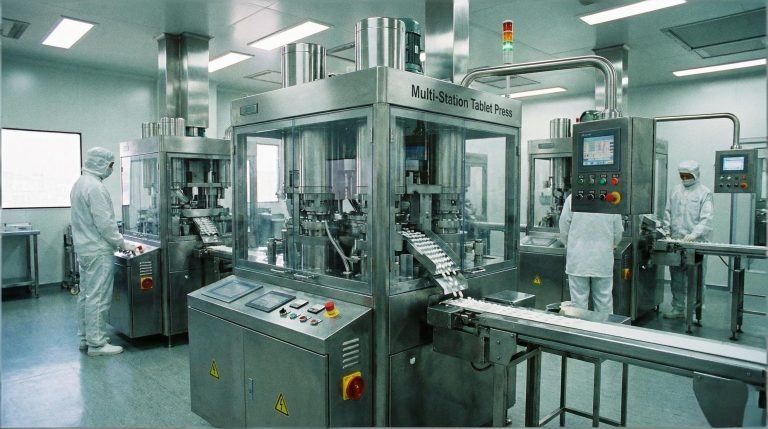
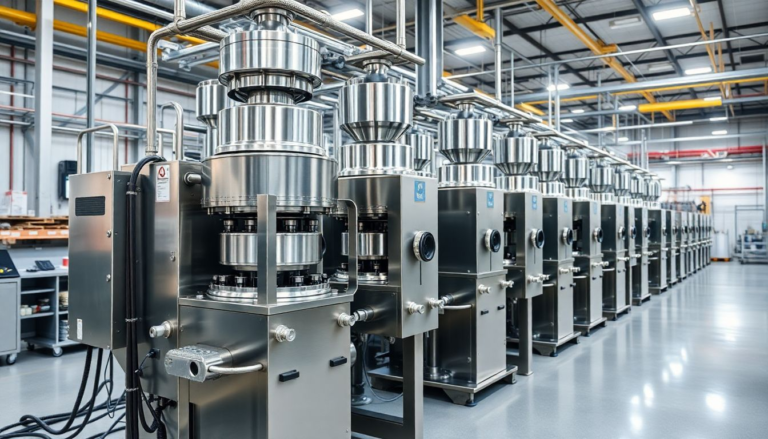
Rotary tablet presses use a rotating turret holding multiple punch-and-die sets. As the turret rotates, punches successively compress material in each die. Output is continuous, and productivity scales directly with the number of stations and turret speed.
Output calculation formula:
Tablets/hour = Number of stations × RPM × 60
A 35-station press running at 40 RPM produces: 35 × 40 × 60 = 84,000 tablets/hour
Rotary Press Categories:
| Category | Stations | Output Range | Price Range (China) | Best For |
|---|---|---|---|---|
| Small Rotary | 8–19 stations | 5,000–40,000 /h | $6,000–$18,000 | Small pharma, nutraceuticals |
| Standard Rotary | 20–35 stations | 40,000–120,000 /h | $15,000–$45,000 | Mid-scale GMP production |
| Large Rotary | 36–55 stations | 100,000–300,000 /h | $35,000–$90,000 | Large-scale commercial production |
| High-Speed Rotary | 56–75 stations | 300,000–1,000,000 /h | $80,000–$200,000+ | High-volume generics, OTC |
3. Bilayer Tablet Press
Bilayer presses produce tablets with two distinct compressed layers — allowing fixed-dose combinations (FDCs) of two incompatible APIs, or modified-release profiles combining immediate and extended-release layers. They require precise weight control for each layer and specialized punch sets.
Price range: $60,000–$200,000. Reserved for complex formulation facilities with validated bilayer processes.
4. Multilayer / Special-Form Press
Includes trilayer presses, ring tablet presses, and shaped-tablet machines (oval, capsule-shaped, embossed). These are specialty configurations purchased for specific product requirements. Price: $80,000–$300,000+.
Critical Technical Specifications Explained
Tooling Standard: B vs. D vs. BB
All rotary tablet presses use standardized punch tooling. The two globally accepted pharmaceutical standards are:
| Standard | Punch Body Diameter | Die Diameter | Max Tablet Size |
|---|---|---|---|
| B-tooling (EU Standard) | 19 mm | 30.16 mm | 16 mm round / 18 mm shaped |
| D-tooling | 25.4 mm | 38.10 mm | 25 mm round |
| BB-tooling | 19 mm | 24 mm | 11 mm round |
Recommendation: Specify B-tooling (EU standard / Euronorm) unless you have an existing D-tooling inventory or are producing very large tablets. B-tooling has the widest global interchangeability and the most competitive aftermarket punch pricing.
⚠️ Avoid non-standard tooling (e.g., proprietary pin-punch systems from low-cost manufacturers). Replacement cost and sourcing lead times become major operational liabilities.
Pre-Compression Force
High-quality rotary presses include a pre-compression stage that applies a small force (1–5 kN) before main compression. This removes air from the granule bed, reduces lamination and capping defects, and extends punch life. Do not purchase a rotary press without pre-compression capability for pharmaceutical production.
Main Compression Force
Main compression force determines tablet hardness. GMP production requires:
- Measurable, controllable main compression force (kN)
- Force measurement accuracy: ±0.5% of target
- Real-time force monitoring with out-of-spec rejection linked to the IPC (In-Process Control) system
Standard range: 40–100 kN for B-tooling presses. High-speed presses: up to 120 kN.
Turret Speed (RPM) and Force Dwell Time
At high RPM, the time available for compression (dwell time) decreases. For poorly compressible APIs, inadequate dwell time causes hardness failure. The relationship is:
Dwell time (ms) = (Flat length of punch head / circumference of compression track) × (60,000 / RPM)
Extended dwell turrets are available as an upgrade for APIs with poor compressibility. Request dwell time data for your target RPM before purchasing.
Hanyoo Tablet Press Product Line
Hanyoo’s tablet press range covers small rotary to high-speed production:
| Model | Stations | Max Output | Tooling | CE Certified |
|---|---|---|---|---|
| ZPT-226 series | 15/19/23 stations | 82,800 /h | B/D EU standard | ✅ |
| ZPT-420 series | 29/35/43 stations | 154,800 /h | B/D EU standard | ✅ |
| GZPT-370 (High Speed) | 26/32/40 stations | 144,000 /h | B/D EU standard | ✅ |
| THP Flower Basket | 6–100 stations | Variable | B/D EU standard | ✅ |
All models include: pre-compression, real-time force monitoring, SS316L contact parts, and full IQ/OQ/PQ documentation.
The 5 Most Expensive Tablet Press Purchase Mistakes
Based on 20 years of supplying equipment to customers in 100+ countries, these are the five mistakes Hanyoo’s engineering team sees most often:
Mistake #1: Buying based on output spec alone
A 55-station press at 60 RPM sounds impressive — but if your granule has poor flow and your facility can only supply 100 kg/batch, you’ll run at 30% capacity. Size the press to your granulation line output, not to a theoretical maximum.
Mistake #2: Ignoring the tooling ecosystem
Punches are consumables. A press with proprietary tooling will cost you 3–5× more per punch set over its lifetime compared to B-tooling with competitive suppliers. Calculate total cost of ownership over 10 years.
Mistake #3: No pre-purchase Factory Acceptance Test (FAT)
Tablets are compressed at the manufacturer’s facility before shipment. If you skip the FAT, you have no baseline data. Problems discovered after installation in your cleanroom are dramatically more expensive to resolve.
Mistake #4: Underspecifying IPC (In-Process Control) integration
Modern GMP requires real-time IPC data (weight, hardness, thickness) to be linked to the press control system and batch record. Presses without integrated IPC force you into manual sampling — a regulatory vulnerability and a labor cost.
Mistake #5: No validation documentation in scope of supply
If DQ, IQ, OQ, and PQ protocols are not included in the purchase contract, you will pay a consultant $20,000–$50,000 to write them. This is a negotiable line item — always include it.
How to Compare Tablet Press Quotes: A Practical Framework
When evaluating competing quotes from multiple suppliers, score each on these criteria:
| Criterion | Weight | What to Check |
|---|---|---|
| Tooling standard | High | B-tooling EU standard? Interchangeable punches? |
| Pre-compression included | High | Standard or optional add-on? |
| IPC integration | High | Real-time weight + force feedback? Batch record output? |
| CE + ISO9001 certificates | High | Valid and verifiable? |
| Validation documentation | High | DQ/IQ/OQ/PQ in scope of supply? |
| FAT availability | Medium | Can they do a tablet run with your formulation? |
| Spare parts commitment | Medium | 10-year parts guarantee? Lead times for wear parts? |
| After-sales support | Medium | Remote diagnostics? Video support? Local service agent? |
Frequently Asked Questions
What is the difference between a single punch and a rotary tablet press?
A single punch tablet press uses one punch set and produces tablets one at a time — maximum output around 4,200 tablets/hour. A rotary tablet press uses multiple punch sets arranged on a rotating turret, producing tablets continuously. A 35-station rotary press at 40 RPM produces 84,000 tablets/hour — 20× more than a single punch press. Single punch presses are appropriate for R&D and clinical trials; rotary presses are required for commercial GMP production.
How much does a rotary tablet press cost?
Rotary tablet press prices from Chinese GMP manufacturers range from $6,000 (small 8–10 station presses) to $200,000+ (high-speed 60+ station presses). The most common production-scale models (20–35 stations) cost $15,000–$45,000. Equivalent European presses (e.g., Fette, Korsch, Romaco) cost 40–60% more for the same specification. All Hanyoo rotary presses include CE certification, B-tooling, and full IQ/OQ/PQ documentation within the standard scope of supply.
What does EU-standard (B-tooling) mean for tablet presses?
B-tooling refers to the standardized punch dimensions defined by the European Pharmaceutical Machinery Association (EUROMAP) and ASTM E2786. A B-tooling press accepts punches from any manufacturer following this standard — giving you competitive sourcing for replacement punches worldwide. D-tooling produces larger tablets (up to 25 mm) but has a smaller global supplier base. Always specify B-tooling unless your product formulation specifically requires D-tooling tablet dimensions.
Can tablet presses from China be used in FDA-approved facilities?
Yes. The FDA evaluates equipment qualification documentation (IQ, OQ, PQ) and design compliance with 21 CFR Parts 210/211 — not country of manufacture. Numerous FDA-inspected facilities in the United States, India, and Europe use Chinese tablet presses with full regulatory acceptance. The requirement is that the equipment is properly qualified and that the manufacturer provides compliant documentation. Hanyoo includes full validation documentation with all production-scale tablet presses.
What maintenance does a rotary tablet press require?
Rotary tablet presses require daily cleaning of contact parts, weekly lubrication of cam tracks and turret bearings, monthly inspection of compression rollers and ejection cams, and quarterly replacement of wear seals. Punch and die inspection should follow a force-monitoring schedule — excessive force variation indicates punch wear. Most Chinese manufacturers recommend a full turret inspection at 500 million tablets compressed. Hanyoo provides a detailed preventive maintenance schedule and spare parts kit with every production press.
Conclusion
Selecting the right tablet press machine is a decision with a 10–15 year operational horizon. The upfront price is rarely the most important variable — tooling compatibility, IPC integration, validation documentation, and after-sales support determine long-term total cost of ownership.
Hanyoo’s tablet press range covers small-scale R&D to high-volume commercial production, with CE certification, EU-standard B-tooling, and full validation documentation included as standard. Our engineering team offers free pre-purchase consultation and FAT tablet trials for all production-scale models.
→ View the full Hanyoo tablet press range or contact us for a quote.
Welcome To Our Pharmaceutical Equipment Line Factory!
Why Choose Us
Specialized Factory
Economical Pricing Options
On-Time Delivery
Perfect Customer Service
Custom Solutions Available
Our technical experts are always ready to assist you in finding the perfect customized solution for your needs.