
Powder Mixing & Blending Equipment Guide
Powder mixing and blending equipment combines active pharmaceutical ingredients with excipients into a homogeneous blend before granulation or direct compression, and the right mixer choice is the difference between a batch that passes content uniformity testing and one that doesn’t. The three workhorse designs — V-blenders, ribbon mixers, and high-shear mixers — differ mainly in mixing mechanism, shear intensity, and how well they handle cohesive or poorly-flowing powders.
Key Takeaways
- V-blenders (and double-cone blenders) use gentle tumble-blending and are the standard choice for free-flowing powders with similar particle sizes, but they struggle with cohesive or fine powders prone to segregation.
- Ribbon mixers use a horizontal trough with a helical ribbon agitator, providing more mechanical mixing action than tumble blenders — better suited to powders with a wider particle size distribution.
- High-shear mixers add an impeller and chopper blade to the mixing action, and are typically the equipment of choice when wet granulation happens in the same vessel as blending.
- Content uniformity (CU) testing per USP <905> is the real pass/fail criterion for blend quality — mixer selection should be validated against your specific formulation’s CU results, not assumed from equipment specs alone.
- Batch sizes for pharmaceutical powder mixers commonly range from lab-scale (5-20L) to production-scale (500-3000L), and mixing time/speed parameters typically need re-validation at each scale-up step.
V-Blenders and Double-Cone Blenders
V-blenders (and the related double-cone design) mix powder through gentle tumbling as the vessel rotates, folding the powder bed over itself repeatedly without significant shear force. This gentle action is well suited to free-flowing powders with similar particle sizes and densities, and it’s a common choice for simple, low-cohesion blends destined for direct compression. The tradeoff: V-blenders are prone to segregation (de-mixing) with powders that have a wide particle size or density distribution, particularly during the discharge step, so they’re not the right default for every formulation. Adding an intensifier bar — a small high-speed agitator mounted inside the V-blender shell — can break up soft agglomerates during the tumble cycle without moving to a full high-shear design, and is a common mid-point upgrade for formulations that are mostly free-flowing but contain a minor cohesive component.
Ribbon Mixers
A ribbon mixer uses a horizontal U-shaped trough with a helical ribbon (often a double or triple ribbon, with inner and outer flights turning material in opposite directions) rotating on a central shaft. The ribbon design actively moves powder both radially and axially through the trough, giving more thorough mechanical mixing than a tumble blender — which makes ribbon mixers a better fit for powders with a broader particle size range, or where some degree of de-agglomeration is needed alongside blending. Ribbon mixers also tend to handle larger batch sizes efficiently and are common in continuous or semi-continuous processing lines. Mixing time in a ribbon mixer is typically shorter to reach acceptable homogeneity than in a V-blender processing an equivalent volume, because the mechanical ribbon action mixes more aggressively per revolution than gravity-driven tumbling.
High-Shear Mixers
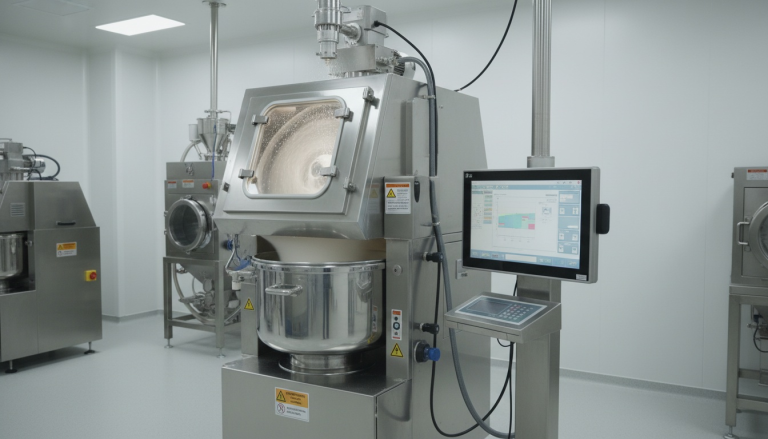
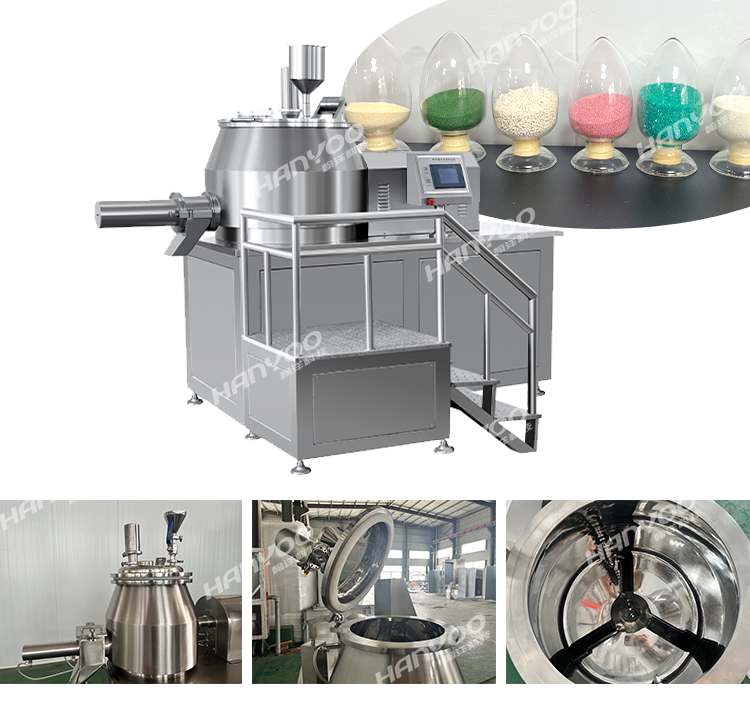
High-shear mixers add an impeller (for bulk mixing) and a separate chopper blade (for breaking up agglomerates) inside a bowl-shaped vessel. Because they can both blend and granulate in the same vessel — adding a liquid binder mid-cycle to trigger wet granulation — high-shear mixers are frequently chosen when a manufacturer wants to combine blending and wet granulation steps rather than running them as separate unit operations. Impeller speed and chopper speed are controlled independently, which lets operators tune bulk mixing intensity separately from de-agglomeration intensity — a level of process control that neither V-blenders nor ribbon mixers offer.
Mixer Comparison
| Factor | V-Blender | Ribbon Mixer | High-Shear Mixer |
|---|---|---|---|
| Mixing mechanism | Gentle tumbling | Helical ribbon agitation | Impeller + chopper |
| Best for | Free-flowing, similar particle size | Wider particle size distribution | Combined blend + wet granulation |
| Segregation risk | Higher at discharge | Lower | Lowest (in-process) |
| Typical batch range | 5–2,000L | 50–3,000L | 5–1,200L |
| Also used for granulation | No | No (typically) | Yes |
Scale-Up Considerations
Mixer scale-up is not a simple linear exercise — geometric similarity (keeping vessel proportions consistent between scales) is a starting point, but mixing time, tip speed, and Froude number relationships need to be checked against actual blend uniformity data at each new scale, not assumed to transfer directly from a smaller unit. A blend that reaches acceptable homogeneity in 15 minutes at a 20L lab scale will not necessarily reach the same homogeneity in a proportionally scaled time at 2,000L — larger vessels often need disproportionately longer mixing times or adjusted rotational speeds to achieve equivalent shear exposure per unit of powder. This is one of the most common sources of unexpected content uniformity failures when a formulation moves from development to commercial-scale production, and it’s why re-validation at each scale-up step is standard practice rather than a formality.
Common Mixing Defects and Troubleshooting
- Segregation during discharge. Even a well-mixed blend can segregate as it flows out of a V-blender or ribbon mixer if there’s a meaningful particle size or density difference between components — mitigated by minimizing free-fall distance during discharge and, where persistent, reconsidering mixer type.
- Dead zones. Poorly designed or overloaded mixers can leave pockets of powder that see minimal agitation, most commonly at vessel corners in ribbon mixers or at the ends of the V in V-blenders — addressed through correct fill-volume limits (typically 40-60% of vessel capacity, though this varies by design) and periodic equipment inspection.
- Over-lubrication. When lubricants like magnesium stearate are blended in a final short mixing step, over-mixing can over-coat particles and impair tablet hardness or dissolution — controlled by tightly specifying and following validated mixing time for the lubrication step specifically.
Validating Mixer Selection
- Run content uniformity testing per USP <905> on trial batches at your target scale — this is the objective measure of whether the chosen mixer and mixing parameters produce an acceptable blend.
- Test at the batch size you’ll actually run in production, not just lab scale — mixing efficiency does not always scale linearly, and re-validation is standard practice at each scale-up step.
- Account for your powder’s flow properties (angle of repose, Carr’s Index) before choosing between a tumble blender and a mechanically agitated mixer — cohesive or poorly-flowing powders generally need the mechanical action of a ribbon or high-shear mixer.
- Map your discharge and transfer path, not just the mixing step itself — a well-homogenized blend can still fail content uniformity at the tablet press if it segregates in a hopper or transfer chute downstream of the mixer.
FAQ
Q: Which mixer type is best for a simple, free-flowing tablet formulation?
A: A V-blender is typically sufficient and cost-effective for free-flowing powders with similar particle sizes destined for direct compression. Confirm with content uniformity testing before finalizing.
Q: Can a high-shear mixer replace a separate granulator?
A: In many cases, yes — high-shear mixers are commonly used for both blending and wet granulation in the same vessel, which can simplify the process train, though the choice still depends on your specific formulation and desired granule characteristics.
Q: How do I know if my powder is prone to segregation in a V-blender?
A: Segregation risk rises with differences in particle size, density, or shape between components, and is most visible during discharge. A formal segregation risk assessment alongside content uniformity testing (USP <905>) on trial batches is the reliable way to check.
Q: Why did my blend pass content uniformity at lab scale but fail at production scale?
A: This is a common scale-up problem — mixing time, tip speed, and fill volume relationships don’t transfer linearly between vessel sizes. Re-validating CU testing at the actual production scale, rather than assuming lab-scale parameters will transfer, is the standard way to catch this before it becomes a batch failure.
Q: What fill volume should I use in a V-blender or ribbon mixer?
A: Most designs perform best in the 40-60% of total vessel capacity range, though the exact figure depends on your specific mixer geometry and powder properties — check your equipment supplier’s validated operating range rather than assuming a single figure applies universally.
Q: Does mixer material of construction matter for pharmaceutical use?
A: Yes — contact parts are typically specified in 316L stainless steel with a defined surface finish (electropolished, with Ra values often specified below 0.8 micron for pharmaceutical applications) to minimize product adhesion, support cleanability, and resist corrosion from cleaning agents used between batches.
Conclusion
Choosing between a V-blender, ribbon mixer, and high-shear mixer comes down to your powder’s flow properties and whether you need blending alone or blending combined with wet granulation. We manufacture all three mixer types to GMP standards with batch sizes scalable from pilot to full production. Request a quote or talk to our engineering team to size the right mixer for your formulation.
References
- USP General Chapter <905> Uniformity of Dosage Units
- ISPE — International Society for Pharmaceutical Engineering
- PIC/S GMP Guide
- ISO 9001 Quality Management Standards
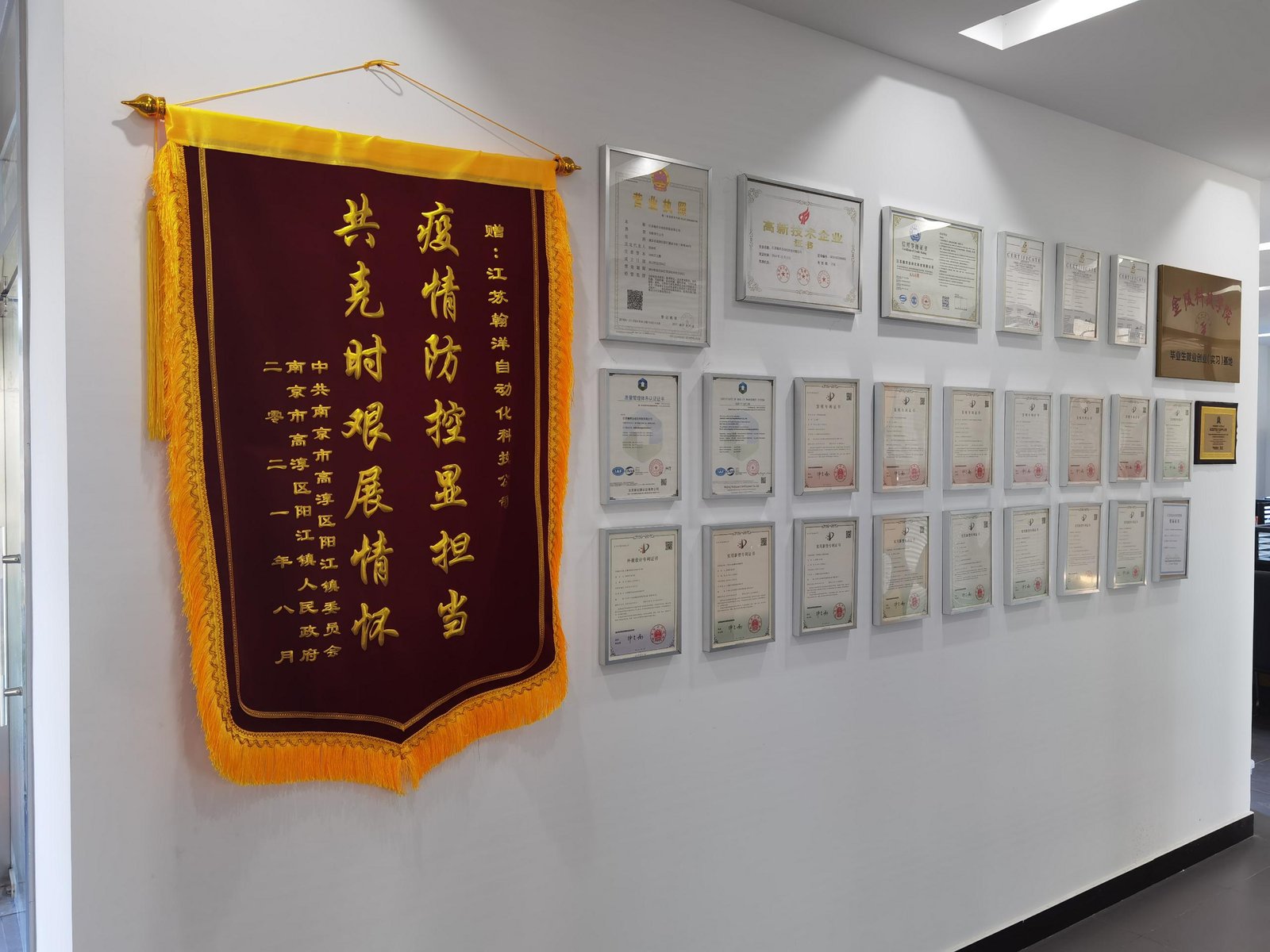
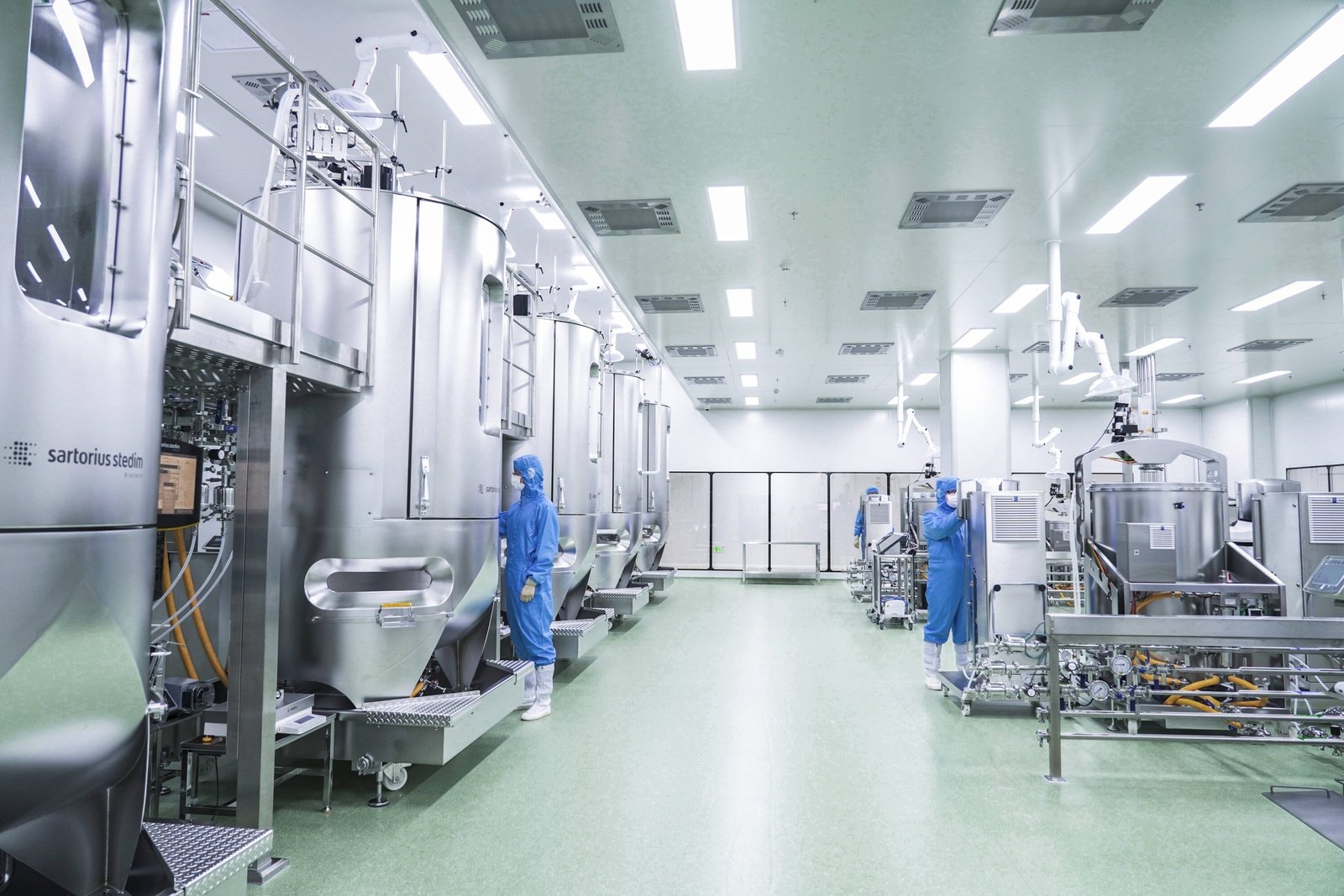
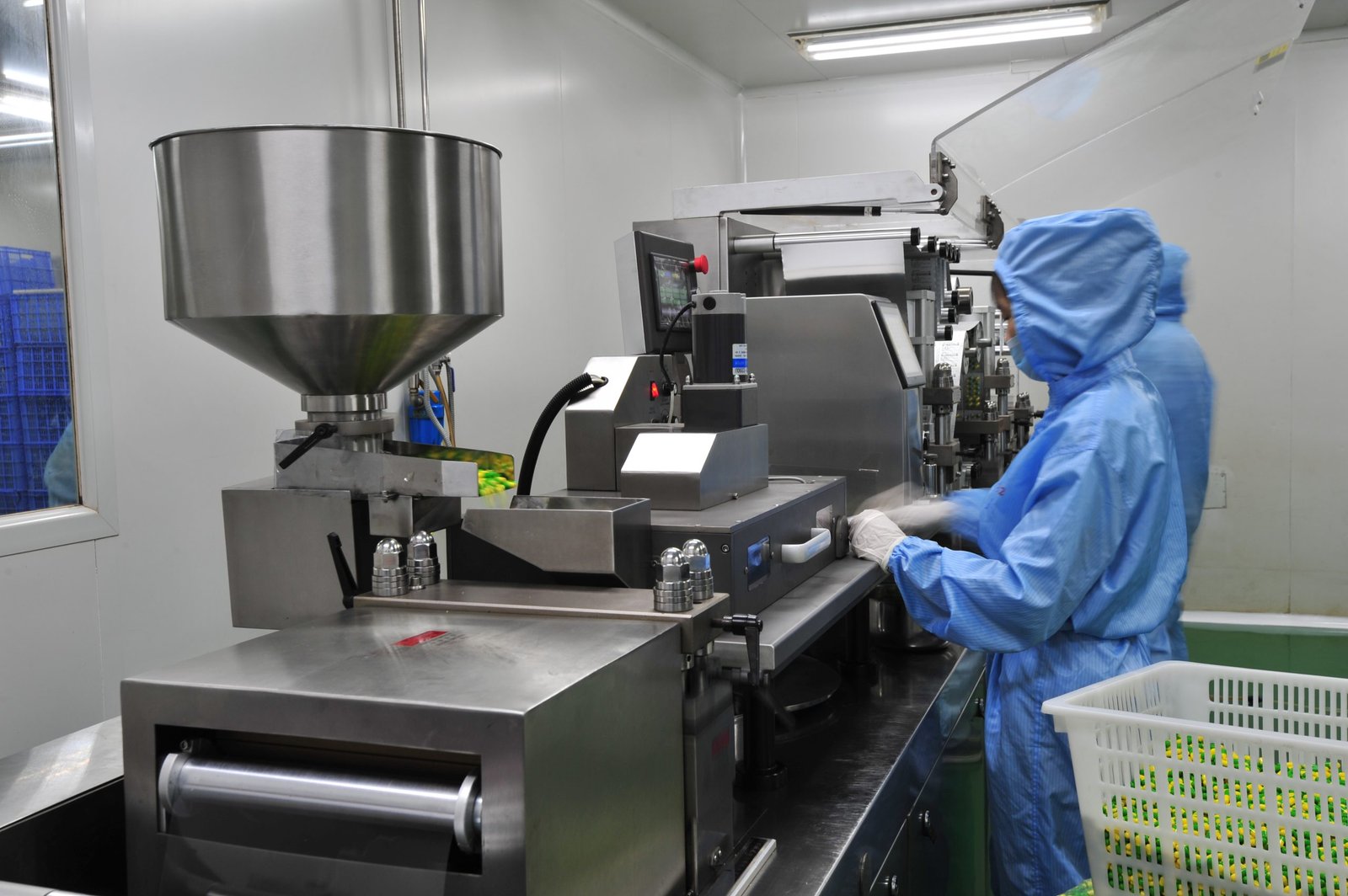
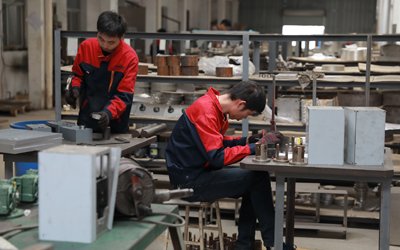
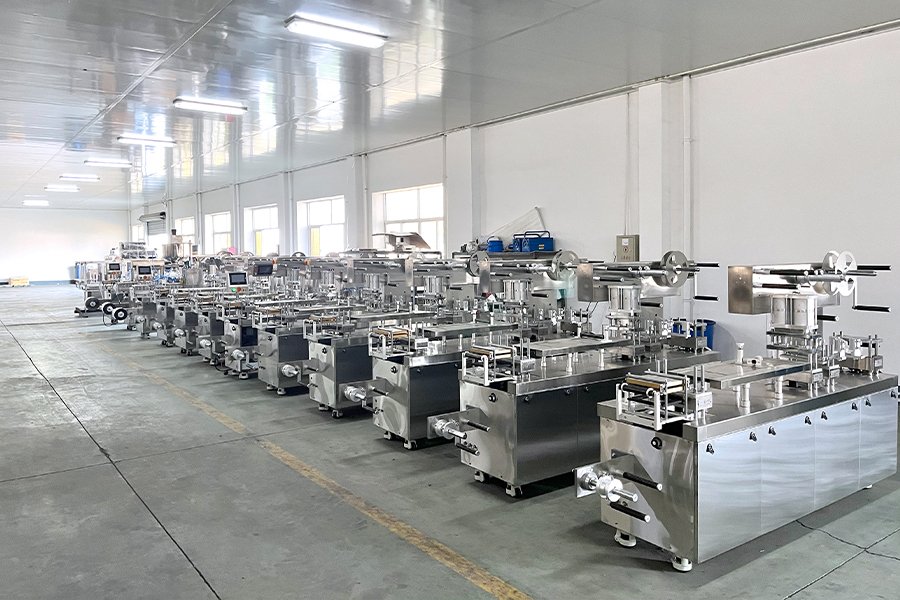
Welcome To Our Pharmaceutical Equipment Line Factory!



Why Choose Us
Specialized Factory
Economical Pricing Options
On-Time Delivery
Perfect Customer Service
Custom Solutions Available
Our technical experts are always ready to assist you in finding the perfect customized solution for your needs.